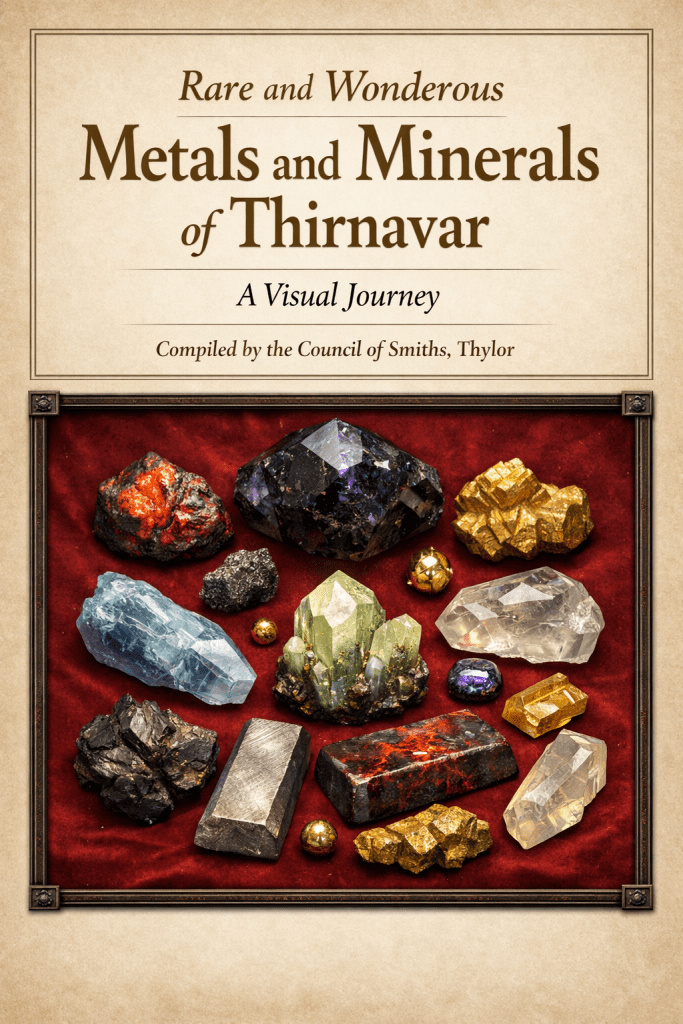
THE METALLURGICAL GUIDE OF THIRNAVAR
A Practical Compendium of Rare Metals, Arcane Alloys, and Geological Curiosities
Compiled for the scholars, smiths, artificers, and explorers of the modern age of Thirnavar.
Introduction
The world of Thirnavar contains a wide variety of unusual metals and mineral substances whose properties extend beyond ordinary metallurgy. Many of these materials possess unusual interactions with magic, life, or extreme environmental conditions.
Some are remnants of the Pre-Fade world, when magic flowed freely and the capabilities of civilization were far greater. Others are products of geological extremes, magical catastrophes, or rare environmental conditions.
This guide collects the most reliable information available regarding these metals, including their appearance, geological origins, physical properties, known uses, and cultural significance.
Many entries remain incomplete due to the rarity of these materials and the limited number of surviving specimens.
_________________________________________________________________________________________________
Batherod
Classification
Reactive Volcanic Metalloid
Geological Occurrence
Forms within unstable volcanic strata where extreme heat and volatile mineral chemistry create reactive compounds embedded in basaltic stone or ash deposits.
Appearance
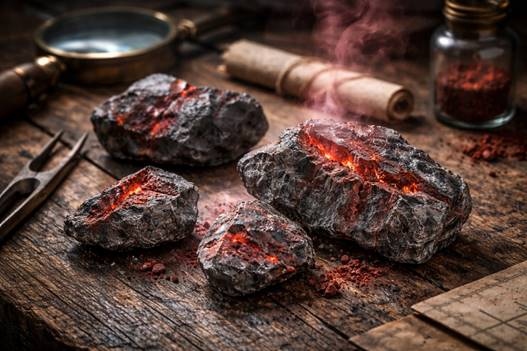
Dull grey nodules threaded with deep crimson crystalline veins. When fractured or exposed to air the red inclusions rapidly sublime, releasing dense scarlet vapor.
Physical Properties
| Property | Description |
| Density | Moderate |
| Hardness | Brittle matrix surrounding unstable reactive inclusions |
| Structural Behavior | Unsuitable for conventional forging |
Reactive / Arcane Behavior
The red inclusions rapidly sublimate when exposed to air, producing corrosive vapors capable of blistering skin and ulcerating lung tissue.
Working Properties
• Cannot be smelted in open air
• Must be handled in sealed alchemical vessels
• Dust is extremely hazardous
Primary Uses
• Catalytic alloy experimentation
• Corrosive acid reagents
• Toxic inhalation compounds
• Volatile alchemical reactions
Known Hazards
• Severe skin blistering
• Permanent lung damage from fumes
• Violent reactions when improperly contained
Rumors / Rare Applications
Tal-Shie smiths are rumored to have stabilized Batherod within rare blades capable of dissolving flesh on contact. The method remains unknown.
_________________________________________________________________________________________________
Vermengd
Classification
Ultra-Dense Metamorphic Metal
Geological Occurrence
Forms deep within ancient mountain roots subjected to immense tectonic pressure.
Appearance
Grey-green metal with faint crystalline banding and muted metallic sheen.

Physical Properties
| Property | Description |
| Density | Extremely high |
| Hardness | Exceptional |
| Structural Behavior | Highly rigid internal lattice |
Reactive / Arcane Behavior
Resists deformation even at extreme temperatures. Only magical manipulation allows reliable forging.
Working Properties
• Requires magically assisted forging
• Usually worked as plating or dense components
Primary Uses
• Armor reinforcement
• Siege shields
• Impact weapon heads
• Structural components
Cultural Use
Among the giants of Kadathe’, ancient Vermengd weapons are treasured clan relics.
_________________________________________________________________________________________________
Alsurene
Classification
Psychoreactive Arcane Metal
Geological Occurrence
Rare veins associated with magical disturbance zones and arcane fault lines.
Appearance
Pale silver metal with faint bluish iridescence and unusually low weight.

Physical Properties
| Property | Description |
| Density | Very light |
| Hardness | Soft |
| Structural Behavior | Cannot hold a cutting edge |
Reactive / Arcane Behavior
Highly responsive to thought and magical intent. Capable of storing arcane energy and resisting electrical discharge.
Working Properties
• Easily shaped
• Extremely receptive to enchantment
Primary Uses
• Arcane focusing devices
• Magical jewelry
• Energy storage artifacts
• Psionic amplification instruments
Known Hazards
Prolonged exposure may influence the mental state of the wielder.
_________________________________________________________________________________________________
Dialomb
Classification
Meteoritic Alloy
Geological Occurrence
Fragments of an ancient meteor scattered across a peat bog on the Isle of Taurdain.
Appearance
Flat black metal with rough surface texture and faint silvery inclusions.

Physical Properties
| Property | Description |
| Density | Moderate |
| Hardness | Very high |
| Structural Behavior | Occurs only in small fragments |
Reactive Behavior
Highly resistant to magical alteration.
Working Properties
• Difficult to purify
• Often reforged into small weapon cores
Primary Uses
• Armor-piercing arrowheads
• Ritual blades
Historical Note
Forging methods were reportedly taught by the dragon Lord Blue
_________________________________________________________________________________________________
Adatatorite
Classification
Elastic Cohesive Metal
Geological Occurrence
Primarily found in the deserts of Deccan and Dracart.
Appearance
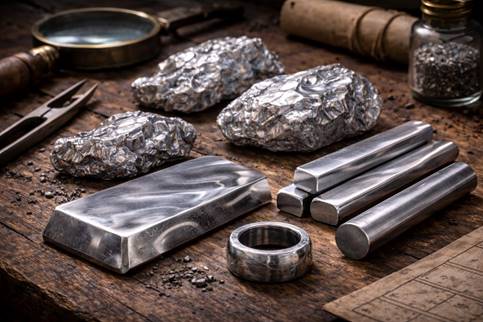
Brilliant silver metal with a flowing surface sheen.
Physical Properties
| Property | Description |
| Density | Moderate |
| Hardness | Durable |
| Structural Behavior | Highly flexible |
Reactive / Arcane Behavior
Capable of bonding with organic tissue when heated.
Working Properties
• Can be drawn into filaments
• Extremely receptive to enchantment
Primary Uses
• Articulated armor joints
• Flexible weapon components
• Advanced prosthetics
_________________________________________________________________________________________________
Shantium
Classification
Decorative Alloying Metal
Geological Occurrence
Imported from Quattar in the Bay of Storms.
Appearance
Metallic flakes producing vivid blue coloration when alloyed.

Physical Properties
| Property | Description |
| Density | Low |
| Hardness | Minimal |
| Structural Behavior | Weak when used alone |
Working Properties
• Easily melts into other metals
• Highly stable once alloyed
Primary Uses
• Decorative armor
• Noble jewelry
• Ceremonial weapons
_________________________________________________________________________________________________
Tarshipi
Classification
Volatile Alchemical Metal
Geological Occurrence
Only confirmed deposits exist in Thylor.
Appearance
Pale yellow crystalline metal.

Physical Properties
| Property | Description |
| Density | Low |
| Hardness | Brittle |
Reactive Behavior
Rapidly sublimates when exposed to air, producing toxic fumes.
Working Properties
• Must be stored in sealed containers
• Only manipulated in alchemical chambers
Primary Uses
• Explosive catalysts
• Toxic gas weapons
• Alchemical reactions
Telazurium
Classification
Pyrophoric Lava Metal
Geological Occurrence
Volcanic regions including Kangga, Turarnadelos, Kalaallit Nunaat, and scattered volcanic islands.
Appearance
Deep crimson metal resembling cooling embers.

Physical Properties
| Property | Description |
| Density | Moderate |
| Hardness | High |
| Structural Behavior | Heat resistant |
Reactive Behavior
Ignites spontaneously when finely divided.
Primary Uses
• Flame enchantment matrices
• Incendiary weapons
• Fire-aligned artifacts
Quassitite
Classification
Encapsulated Reactive Metal
Geological Occurrence
Geothermal fields of Turarnedelos.
Appearance
Earth-colored nodules containing metallic cores.

Physical Properties
| Property | Description |
| Density | Moderate |
| Hardness | Fragile shell |
Reactive Behavior
The inner metal reacts violently when exposed.
Primary Uses
• Explosive catalysts
• Alchemical energy reactions
Ulabony
Classification
Flexible Metallic Compound
Appearance
Smooth silver-grey metal with rubberlike flexibility.

Physical Properties
| Property | Description |
| Density | Moderate |
| Hardness | Flexible |
| Structural Behavior | Returns slowly to original form |
Primary Uses
• Flexible weapons
• Shock-absorbing armor joints
Cultural Note
Extensively used by the Tal-Shie.
Yadrakk
Classification
Arcane Storage Metal
Appearance
Dark grey metal with faint internal rune-like grain.

Properties
Stores arcane energy and remains reusable after discharge.
Primary Uses
• Spell ammunition
• Arcane batteries
• Magical focusing devices
Silabony
Classification
Necromantic Disruption Metal
Appearance
Deep matte black metal that absorbs light.

Properties
Disrupts necromantic energies but is somewhat brittle.
Primary Uses
• Anti-undead weapons
• Crypt warding artifacts
• Necromantic defense armor
Aurabony
Classification
Pre-Fade Dragonforged Metal
Appearance
Pale gold metal with perfectly smooth surface.

Properties
• Immune to heat
• Cannot be reforged by modern techniques
• Permanently stabilizes enchantments
Status
All known artifacts originate from the Pre-Fade era.
Ethril
Classification
Artificial Alchemical Metal
Appearance
Dull black metal with faint green edges.

Properties
• Extremely light
• Strong as steel
• Toxic to elves
Status
Outlawed across most civilized realms.
Blachurium
Classification
Hypothetical Living Metal
Appearance (theoretical and rumored)
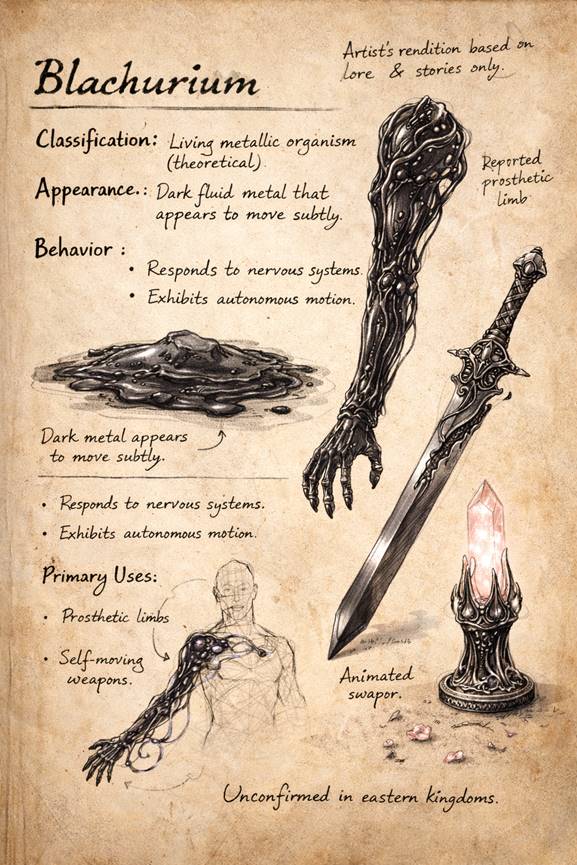
Described as a dark fluid metal capable of subtle movement.
Behavior
May respond to nervous systems and exhibit autonomous motion.
Status
No confirmed specimens exist.
Cadrium
Classification
Extreme Heat Resistant Metal
Appearance
Dense grey metal heavier than lead.

Properties
Withstands extraordinary temperatures.
Primary Uses
• Forge linings
• Crucibles
• High-temperature weapon cores
Stellian
Classification
Elven High-Strength Alloy
Appearance
Bright polished silver metal.

Properties
• Half the weight of steel
• Four times the strength
Primary Uses
• Elite elven weapons
• Lightweight armor
Rosarium
Classification
Photoreactive Metal
Appearance
Pale rose metal.

Properties
Absorbs sunlight and glows for roughly twenty minutes after exposure.
Primary Uses
• Signal devices
• Decorative objects
• Arcane instruments
Bronzahrium
Classification
Corrosion-Proof Naval Alloy
Appearance
Warm bronze metal with gold undertones.

Properties
Does not rust or tarnish.
Primary Uses
• Ship hull plating
• Marine fittings
• Naval armor
Varitium
Classification
Arcane Dampening Metal
Appearance
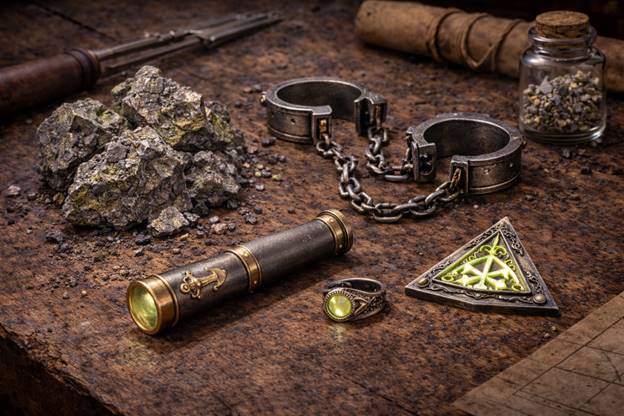
Geological Origin
Often found at sites of catastrophic magical events.
Properties
• Dampens arcane magic
• Unaffected by divine magic
Primary Uses
• Anti-magic jewelry
• Mage prison shackles
• Defensive wards
Eog
Classification
Necrotoxic Crystal Metal
Appearance
Clear crystal spires with black metallic cores.

Properties
Highly toxic and destructive to living tissue.
Primary Uses
• Assassin weapons
• Alchemical poisons
• Necromantic reagents
Glykys
Classification
Alloy Catalyst Metal
Geological Occurrence
Occurs in thin veins within sedimentary formations containing silica-rich rock.
Appearance

Raw ore resembles dull brown-grey stone with cherty inclusions and faint metallic sparkles. Refined metal appears as small silver-grey granules.
Physical Properties
| Property | Description |
| Density | Moderate |
| Hardness | High when alloyed |
Metallurgical Behavior
When added in trace quantities to copper alloys, Glykys dramatically strengthens the metal while preserving corrosion resistance and copper coloration.
Typical alloy ratio:
Copper: 95–97%
Glykys: 2–3%
Primary Uses
• Decorative armor plates
• Weapon fittings
• Naval corrosion-resistant components
Visual Traits
Produces a burnished copper color with stable reddish patina.
Guild Note
A single pound of Glykys can strengthen hundreds of pounds of copper alloy, making it strategically valuable.
Veilglass
(also known as Lénoraël)
Classification
Translucent Arcane Silicate Metal
Geological Occurrence
Veilglass is believed to form where high silica deposits are exposed to intense magical distortion over long periods, especially in regions where the boundary between the material world and unseen forces has thinned. It is most often found in pale crystal seams, broken fault pockets, or old ritual sites where glass and metal seem to have fused together.
Appearance
Veilglass appears translucent and pale opaline, threaded with silver-blue swirls that shimmer like heat haze beneath the surface. In strong light it seems almost half-solid, as though depth and distance within the material do not behave normally.

Physical Properties
| Property | Description |
| Density | Low to moderate |
| Hardness | High but brittle under sharp impact |
| Structural Behavior | Holds fine shapes well but dislikes sudden stress |
Reactive / Arcane Behavior
Veilglass appears unusually receptive to illusion, divination, and warding magic. Arcane light often diffuses through it rather than stopping at the surface, and some artificers claim it can distort magical sight in subtle ways. It is not strongly durable in shock-bearing applications, but it is exceptionally stable as a medium for enchantment.
Working Properties
• Difficult to smelt by conventional methods
• Must be worked slowly under controlled heat to prevent internal fracturing
• Takes carving, inlay, and rune etching extremely well
• Poor choice for heavy impact tools or battlefield weapons
Primary Uses
• Lenses and arcane viewing instruments
• Warding plates and ritual panels
• Illusion-bound jewelry and ceremonial objects
• Decorative inlays in staffs, reliquaries, and high ritual devices
Known Hazards
• Can shatter unpredictably if struck when under magical tension
• Fragments may distort light and sight in disorienting ways
• Mishandled enchantments may create lingering visual mirages around the object
Rumors / Rare Applications
Some old elven accounts suggest Veilglass was once used in hidden chambers, mirrored sanctums, and veil-wards meant to obscure entire rooms from hostile divination. The name Lénoraël is usually preferred in older scholarly or elven records.
Umbracite
Classification
Shadow-Reactive Arcane Metal
Geological Occurrence
Umbracite is thought to form in deep strata touched by both mineral pressure and prolonged magical saturation, particularly in cavern systems, lightless faults, or places marked by repeated shadow workings. It is rarely found in large deposits and often appears as narrow veins buried in dark stone.
Appearance
Umbracite is a black-violet metal whose surface seems to absorb light rather than reflect it. In the presence of strong magic, faint purple veins crawl slowly across its surface like living capillaries.

Physical Properties
| Property | Description |
| Density | Moderate to high |
| Hardness | High |
| Structural Behavior | Stable and strong, though somewhat resistant to refinement |
Reactive / Arcane Behavior
Umbracite is strongly responsive to concentrated magical force. Rather than channeling energy openly, it appears to dampen, swallow, or redirect portions of ambient radiance and magical glow. This makes it particularly valuable for concealment, containment, and items intended to function discreetly in enchanted environments.
Working Properties
• Difficult to polish to a bright finish
• Requires steady magical heat or prolonged forge time
• Holds edges and rigid forms well
• Highly resistant to decorative etching unless done with enchanted tools
Primary Uses
• Concealed blades and assassin tools
• Arcane housings meant to suppress glow or visible signatures
• Shadowed armor fittings and anti-scrying casings
• Reliquaries or containment boxes for dangerous magical objects
Known Hazards
• Prolonged exposure during active spellwork can produce nausea, headaches, or a sense of oppressive dimness
• Some mages report weakened spell visibility when using Umbracite instruments
• Improperly enchanted pieces may interfere with nearby light sources or minor cantrips
Rumors / Rare Applications
A few artificers speculate that Umbracite could serve as the outer shell of advanced arcane prisons or anti-divinatory vaults. Some darker traditions are said to favor it for ritual knives that leave little magical trace.
Sélvarine
(Living Silver)
Classification
Living Arcane Metal
Geological Occurrence
Sélvarine is believed to form where silver-bearing veins are altered by potent life-attuned magic, deep mineral warmth, or ancient growth-sites saturated with long-lasting enchantment. It is extremely rare and is often recovered in small fluidic nodules rather than conventional ore masses.
Appearance
Sélvarine resembles liquid silver threaded with veins of deep turquoise that ripple slowly with motion. It is slightly warm to the touch, and even when at rest its surface seems subtly alive.

Physical Properties
| Property | Description |
| Density | Moderate |
| Hardness | Variable depending on its settled state |
| Structural Behavior | Unusually adaptive, capable of flowing slightly before re-stabilizing |
Reactive / Arcane Behavior
Sélvarine appears responsive to touch, heat, living tissue, and directed magical intent. It seems to settle more readily into forms it is repeatedly encouraged to hold, making it especially valuable for adaptive fittings, prosthetics, and items requiring intimate connection to a user.
Working Properties
• Extremely difficult for ordinary smiths to predict
• Best shaped through repeated guided heating and enchantment rather than brute hammering
• Highly compatible with living interfaces, articulated structures, and responsive mechanisms
• Can lose stability if forced too quickly into rigid forms
Primary Uses
• High-grade prosthetics and articulated supports
• Living jewelry or regalia that conforms to the wearer
• Elite magical foci requiring a bond with a specific user
• Fine adaptive armor segments and ceremonial handwork
Known Hazards
• Improper bonding may result in partial fusion with cloth, leather, or flesh
• Overworked pieces may become slack, unstable, or semi-fluid for a time
• Some handlers report faint responsive movement even when the metal is supposedly inert
Rumors / Rare Applications
The most ambitious theories suggest Sélvarine can be taught rather than merely shaped. There are whispers of ancient pieces that “remembered” their owners and adjusted themselves without command.
Embershale
Classification
Thermally Active Fire Metal
Geological Occurrence
Embershale forms in volcanic shelves, lava tunnels, and deep burned strata where metal-rich stone cools unevenly around pockets of trapped heat and mineral combustion. It is often recovered from cracked plates or shelves rather than conventional ore nodules.
Appearance
Embershale is ashen-black metal split by glowing red fissures that pulse softly like breathing coals. The glow deepens under heat, strain, or magical stimulation.

Physical Properties
| Property | Description |
| Density | Moderate to high |
| Hardness | High |
| Structural Behavior | Strong under heat, somewhat temperamental when rapidly cooled |
Reactive / Arcane Behavior
Embershale holds and redistributes heat exceptionally well. Rather than merely resisting fire, it seems to carry thermal force through its body in a controlled way. This makes it useful for furnacework, fire-bound weapons, and engineered heating systems.
Working Properties
• Requires careful temperature control during forging
• Quenches poorly and may crack if cooled too fast
• Best worked in long heat cycles
• Pairs well with flame enchantment and furnace applications
Primary Uses
• Fire-aligned weapon cores
• Forge plates, braziers, and heated mechanisms
• Armor elements intended to endure flame exposure
• Incendiary tools, siege inserts, and ritual fire devices
Known Hazards
• Retains heat longer than expected
• Hairline fissures may flare under pressure or magical load
• Mishandling can cause burns even when the metal looks dormant
Rumors / Rare Applications
Some siegewrights believe Embershale could be used in reusable incendiary engine heads or sustained heat projectors. In older lore, certain fire cults treated it as a sleeping ember from the bones of the world.
Aeryllith
Classification
Resonant Featherlight Alloy
Geological Occurrence
Aeryllith is thought to form only where rare noble metals are subjected to prolonged elemental air influence, high-altitude magical pressure, or ancient sky-borne mineral deposition. It is seldom mined in quantity and is more often recovered from thin, delicate seams in elevated or wind-scoured terrain.
Appearance
Aeryllith is a featherlight silver-gold alloy with a frosted sheen. It constantly emits a faint hum or chiming resonance, especially when moved, suspended, or exposed to wind.

Physical Properties
| Property | Description |
| Density | Extremely low |
| Hardness | Moderate |
| Structural Behavior | Light, springy, and surprisingly stable for its mass |
Reactive / Arcane Behavior
Aeryllith appears naturally sympathetic to air, motion, vibration, and resonance. Its faint tonal output suggests a constant internal harmonic structure. Enchanters value it for objects tied to swiftness, sound, levitation, precision balance, and delicate magical conduction.
Working Properties
• Easy to move and shape but difficult to control because of its low mass
• Requires fine tools and a gentle hand rather than brute forging force
• Poor for heavy impact applications
• Excellent for lightweight precision work and resonance-sensitive devices
Primary Uses
• Lightweight elite weapons and spear shafts
• Air-aligned foci, chimes, and signal instruments
• High-grade ornamented armor components where weight matters
• Mechanisms relying on balance, motion, or tonal resonance
Known Hazards
• Easily warped by careless handling during finishing
• Resonant feedback may disrupt delicate enchantment work if not accounted for
• Thin pieces may vibrate audibly in dangerous environments, compromising stealth
Rumors / Rare Applications
There are stories of Aeryllith being used in sky-craft fittings, floating reliquaries, and blades so light they seemed to move before the wielder fully committed to the strike.
Sandquartz Alloy
(also called Draekir Duststeel)
Classification
Silicate-Bound Desert Alloy
Geological Occurrence
Sandquartz Alloy is not usually found in a natural pure state, but produced from desert metals fused with silica-heavy sands under intense heat. The finest forms are associated with the furnaces and glass-rich forges of arid lands, especially where natural heat, red mineral dust, and volcanic or alchemical methods can be combined.
Appearance
This alloy appears as gritty-textured bronze threaded with sparkling grains of fused glass and scattered glowing red-orange specks. Its surface is rougher than most refined metals, but it takes a fierce, desert-born beauty when polished correctly.

Physical Properties
| Property | Description |
| Density | Moderate |
| Hardness | High |
| Structural Behavior | Abrasion-resistant, rigid, and somewhat coarse under fine tooling |
Reactive / Arcane Behavior
The glass-bearing matrix gives the alloy unusual resistance to scouring wear, heat shimmer, and surface erosion. The glowing mineral specks suggest retained thermal or arcane charge, making it especially suitable for desert warfare, furnace tools, and weapons exposed to harsh conditions.
Working Properties
• Hard on tools and difficult to finish smoothly
• Requires high heat and careful impurity control during alloying
• Best suited to robust shapes rather than delicate filigree
• Holds broad edges, points, and armor plates well
Primary Uses
• Desert weapons and hard-wearing armor plates
• Furnace tools and abrasive work surfaces
• Spearheads, cleavers, and edged implements meant for harsh climates
• Reinforced fittings for caravans, siege engines, and sand-worn machinery
Known Hazards
• Glass-bearing dust produced during grinding can be harmful if inhaled
• Inferior batches may contain brittle pockets that shear unexpectedly
• Rough unfinished edges are prone to micro-chipping
Rumors / Rare Applications
Among some southern smiths, Draekir Duststeel is praised as a practical war-metal of heat, grit, and endurance. Exceptional pieces are said to hold enchantments of fire, sun, or endurance better than common bronze or iron.
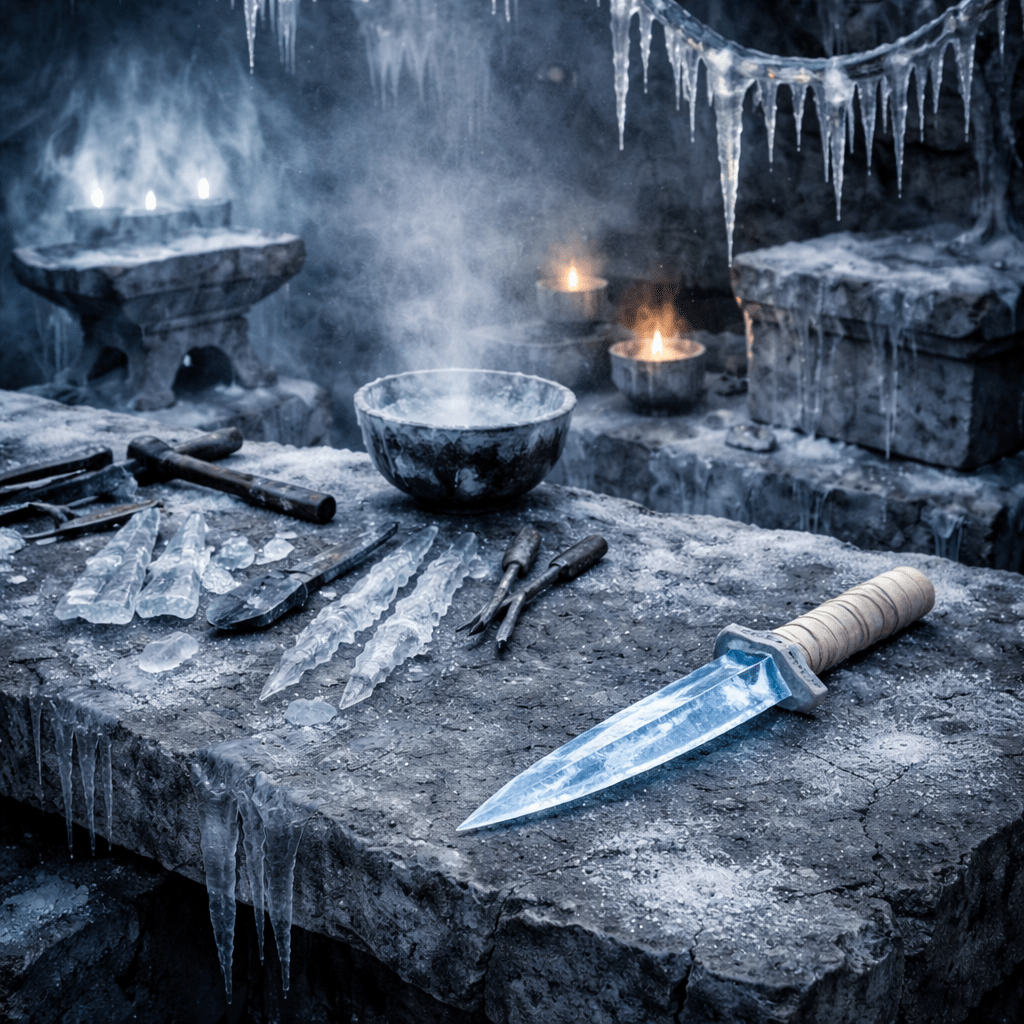
Buragil — The Breath-Frozen Metal
“Fire tempers steel. Cold reveals truth.”
— fragment from a shattered Kadathe’ runestone
Overview
Buragil is a pre-Fade draconic metal of the far north, a substance that is not merely cold but belongs to cold. It cannot be forged by heat. It rejects flame. It softens only under extreme freezing, becoming workable at temperatures that would kill any mortal smith within minutes.
Modern metallurgists often misidentify Buragil as memory glass, glass-steel, or some exotic alloy. These conclusions are understandable but wrong. Buragil predates those traditions by millennia.
Its true origin lies in a lost pact between ancient northern peoples and the great ice dragons.
It is not mined in a conventional sense.
It is gifted.
Physical Nature
Buragil resembles deep glacial ice at first glance, but closer inspection reveals metallic grain beneath its translucent surface.
Color: Pale blue-white with faint internal striations
Transparency: Semi-translucent; thicker pieces appear opaque
Surface: Smooth as frozen water, impossible to polish further
Weight: Slightly lighter than steel
Temperature: Always cold to the touch, never reaches ambient warmth
When struck, it produces a clear, bell-like tone that carries unnaturally far in winter air.
Thermal Behavior
Buragil inverts the laws of metallurgy.
Heat Response
- Becomes brittle when warmed
- Can fracture explosively if exposed to intense heat
- Cannot be forged or reshaped above freezing temperatures
- Fire magic actively damages its structure
Cold Response
- Becomes slightly pliable at extreme sub-zero temperatures
- Achieves workable state only in supernatural cold
- Retains shape permanently once warmed again
Ancient texts describe smithing halls built into glaciers, where the air itself could freeze breath solid.
Draconic Forging
True Buragil was formed through a process no longer understood:
- Ore or proto-metal exposed to sustained ice dragon breath
- Infusion with draconic magic during crystallization
- Shaping performed in temperatures far below mortal survival limits
- Final quenching in magically frozen water or blood-ice
No known modern technique can replicate this.
Even possessing an ice dragon would not guarantee success. The ritual knowledge is gone.
Mechanical Properties
Buragil combines contradictory qualities:
Strength
- Harder than high steel
- Exceptional edge retention
- Resistant to deformation
- Immune to rust or corrosion
Brittleness Threshold
- Tough in cold climates
- Risk of fracture in hot environments or fire exposure
- Performs best in winter or polar regions
Impact Behavior
Instead of bending, Buragil transmits force through its entire structure, often producing devastating shock effects.
Supernatural Traits
Buragil does not merely exist in cold — it anchors cold into the world.
Commonly observed phenomena:
- Frost forms along its edges in humid air
- Snow near it falls more heavily or settles unnaturally
- Water in contact with it freezes rapidly
- Heat seems muted nearby
Powerful pieces may suppress fire or weaken flame-based magic.
Relationship to Dragons
Buragil carries an echo of its draconic origin.
Those attuned to primal forces report:
- A distant sense of vast age
- A predatory stillness
- Something akin to patience rather than hostility
Some northern traditions believe Buragil weapons choose their wielders, remaining inert or even dangerous in unworthy hands.
Rarity
Buragil is among the rarest materials in Thirnavar.
Known sources include:
- Relics from pre-Fade civilizations
- Gifts from ancient ice dragons
- Weapons recovered from glacial tombs
- Objects entombed in permanent ice
Most nations do not recognize it for what it is.
Many pieces likely sit in treasuries mislabeled as exotic crystal or enchanted glass.
Modern Understanding
No living smith can produce Buragil.
At best, craftsmen can:
- Repair minor damage using extreme cold techniques
- Mount Buragil components into new weapons
- Study its properties without comprehension
Attempts to melt or reforge it have universally destroyed the material.
Combat Characteristics
Weapons made from Buragil exhibit unique battlefield behavior:
- Edges bite deeply with minimal effort
- Strikes carry penetrating cold shock
- Armor becomes brittle under repeated blows
- Frost accumulates along wounds
Against creatures of heat or flame, Buragil is especially devastating.
Against fire-forged constructs or magma entities, it can be catastrophic.
Buragil and Rimeheart
Rimeheart is not merely made from Buragil — it is a masterwork of the lost tradition.
Signs supporting this:
- Impossible durability despite massive size
- Cold aura that never fades
- Resistance to fire damage
- Bell-clear impact tone
- Misidentification as memory glass by modern scholars
Most surviving Buragil objects are small blades, tools, or fragments.
A full two-handed weapon forged from it suggests:
- Direct draconic involvement
- Royal or mythic status
- Pre-Fade craftsmanship of the highest order
Cultural Memory in the North
Among Kadathe’ and related northern traditions, faint echoes remain:
- Legends of “cold-forged kings”
- Stories of dragons gifting weapons before great wars
- Ritual taboos against heating ancient blades
- Burial rites involving frozen tombs
Many of these customs likely originate from forgotten knowledge of Buragil.
Why It Is Nearly Unknown Today
Several factors contributed to its disappearance:
- Loss of draconic alliances
- The Fade disrupting ancient magic
- Collapse of polar civilizations
- Extreme difficulty of working conditions
- Destruction of glacial forges
Unlike steelmaking, Buragil forging cannot be rediscovered through trial and error. It requires conditions that modern societies cannot easily create or survive.
Identification Clues (for Scholars)
True Buragil can be distinguished from memory glass or glass-steel by:
- Metallic resonance when struck
- Lack of internal flaws or bubbles
- Cold persistence even in warm environments
- Resistance to scratching despite translucent appearance
- No softening under flame
The most definitive test: exposure to extreme cold slightly increases its resilience instead of making it brittle.
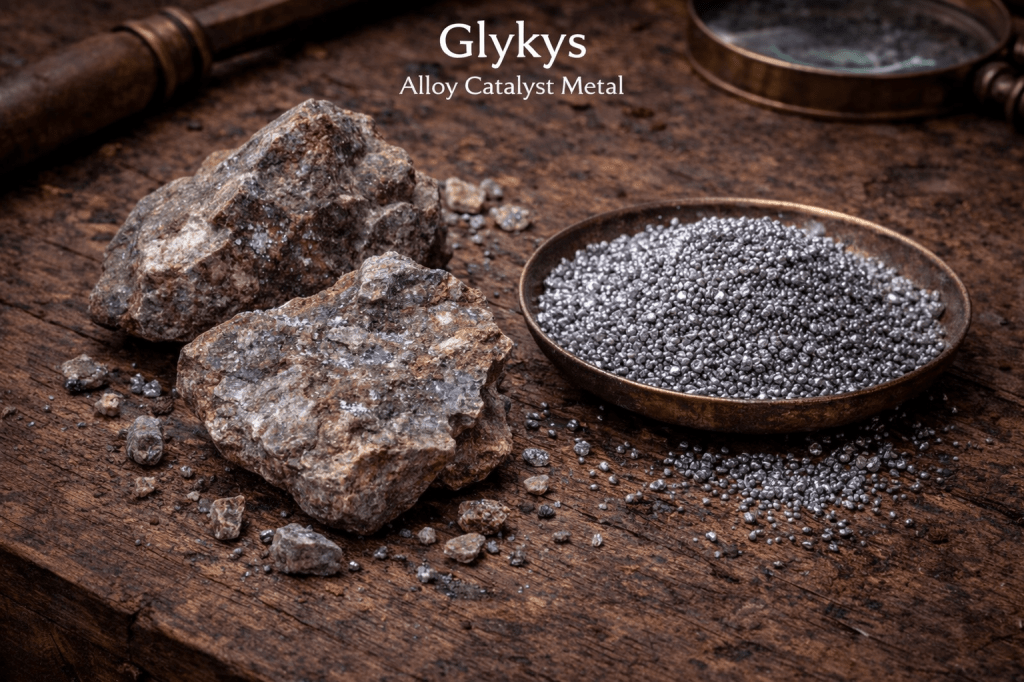
Glykys
Classification Alloy Catalyst Metal
Geological Occurrence
Occurs in thin veins within sedimentary formations containing silica-rich rock. please generate a new ai image similar to all the other ones for metals and materials listed here for this metal. Appearance Raw ore resembles dull brown-grey stone with cherty inclusions and faint metallic sparkles. Refined metal appears as small silver-grey granules.
 Thirnavar